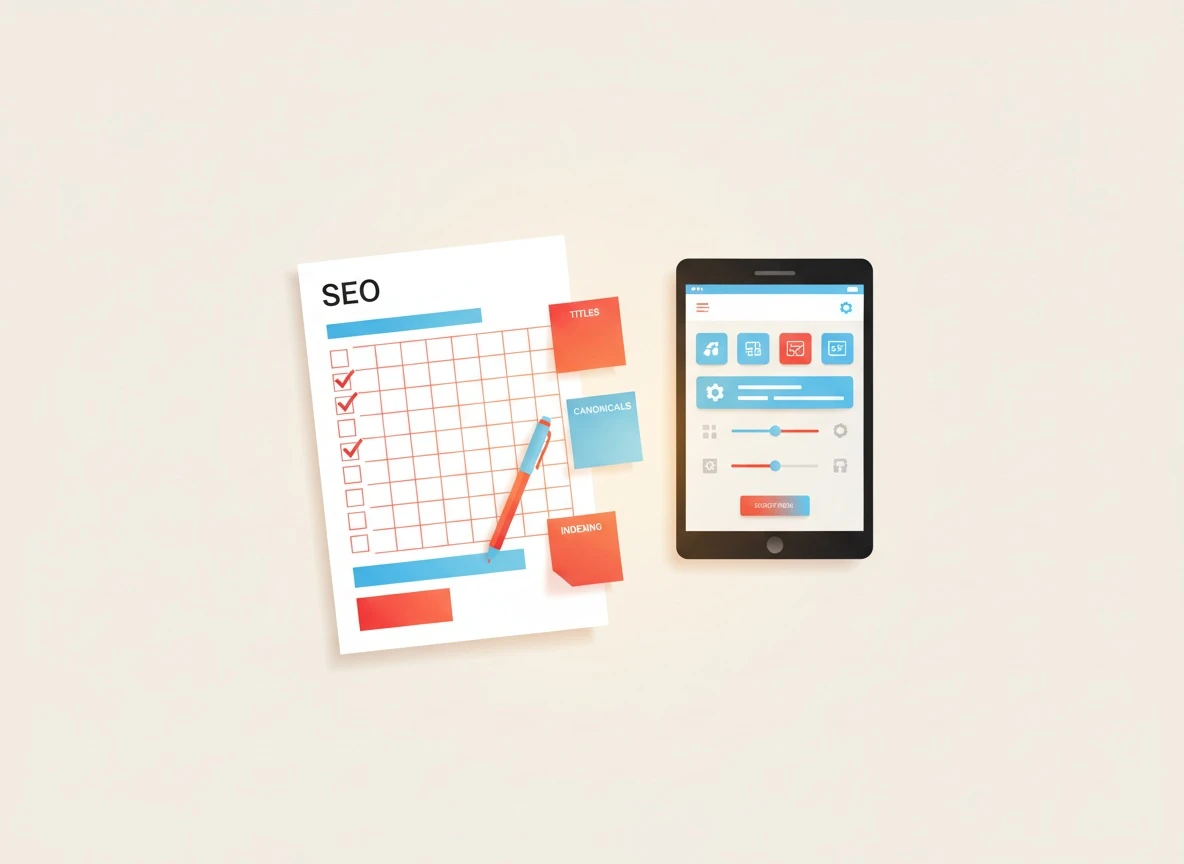
SEO web design in the Wix Editor is mostly about getting the “boring” settings right without accidentally breaking your layout: clean URL slugs, indexable pages, correct canonicals, reliable redirects, and a sitemap that Search Console actually trusts. This guide walks you through the exact Wix Editor setup that keeps your design intact while making your pages easier to crawl, index, and rank
How does the Wix Editor affect SEO and indexing?
The Wix Editor affects SEO the same way any site builder does: it controls , which directly influence crawling and indexing. The good news is that Wix has matured a lot on technical SEO. The bad news is that migrations and template swaps still create predictable SEO breakpoints if you do not plan the Editor changes in the right order.
HTML output, internal linking, URL patterns, and performance
Here are the failure modes I see most when someone migrates from a template, the Wix free website builder starter setup, or another platform:
Pages get duplicated (old and new versions both exist), and Google indexes the wrong one. That is a canonical and internal linking problem, not a “content quality” issue.
URL slugs change because someone renames pages late in the build. Wix will not magically preserve your old URLs unless you set redirects. Rankings drop fast when high-value pages start returning 404s.
Navigation gets “prettier” but less crawlable. If your important pages are only reachable through buttons inside a hero section, you have effectively hidden them from your own internal link graph.
Performance regressions happen after adding animations, video backgrounds, or heavy apps. Google has been explicit that user experience and performance signals matter, and Core Web Vitals are still a measurable part of that system. Google’s own documentation is the reference point: Core Web Vitals.
A practical principle: Wix Editor is not your SEO problem. Uncontrolled change is. If you treat the Editor like a deployment environment (plan, change, verify), Wix can rank very well.
If you want the bigger context on why “good content” still fails without the right setup, keep why great content still doesn’t rank handy as a diagnostic companion.
What settings in Wix Editor matter most for Google?
Wix Editor settings that matter for Google fall into two buckets: what Google sees on the page (on-page SEO services basics) and what Google’s crawler needs to trust your site (technical SEO).
Page-level essentials: titles, descriptions, headings, alt text
Wix makes these accessible, but you still have to use them correctly.
Meta title and meta description: In Wix, each page has SEO settings where you set the title and description. Do not copy-paste the same title across ten pages. Google rewrites titles when they are repetitive or misaligned with intent. Google explains how it generates titles in search results in its own docs: how Google creates titles.
Heading tags (H1, H2): Your page should have one clear H1 that matches the page’s purpose. Wix Editor can accidentally create multiple H1s when you use themed text styles inconsistently. I have audited Wix sites where every section header was an H1 because the designer used a “Heading 1” style for visual consistency. That is a semantics problem, not a design problem. Use styles that map to correct heading levels.
Image alt text: Wix is fine here, but most sites skip it. Add alt text for meaningful images (product photos, portfolio examples, diagrams). Skip decorative shapes. Alt text is not a keyword dump; it is a description that helps accessibility and image search relevance.
Indexing toggles: Wix lets you set whether a page is indexable. During migrations, teams often set “noindex” on staging pages and forget to remove it. Before launch, you should check every money page (services, product categories, lead-gen pages) is indexable.
Canonical tags: Wix handles canonicals automatically for most standard pages, but you can still create canonical confusion with duplicate pages, parameterized URLs, or multiple versions of the same content. Your goal is simple: one primary URL per intent.
XML sitemap: Wix generates a sitemap for you. You do not need an xml sitemap generator or sitemap generator plugin in most cases. What you do need is to verify the sitemap is accessible and includes the right pages (and excludes noindex pages). Then submit it in Search Console.
Robots.txt: Wix provides a robots.txt file, but you should treat it as a safety mechanism, not a primary SEO tool. Robots does not remove indexed pages; it only blocks crawling. If you block crawling of a page that is already indexed, Google can keep it indexed with stale signals.
One sentence worth remembering because it saves months of confusion: Noindex removes pages; robots.txt blocks crawling. They are not interchangeable.
How do you structure pages, menus, and internal links in Wix?
The fastest path to better SEO in web development is usually not a “settings” tweak. It is a structure fix: fewer orphan pages, clearer intent per URL, and internal links that distribute authority.
Start with a simple URL architecture (before design polish)
When migrating, decide your final URL structure early. Wix lets you edit URL slugs per page, but late changes create redirect debt.
A clean structure typically looks like:
Page type
Good URL pattern
Common mistake
Home
/
Stuffing every keyword into the homepage title
Service
/services/service-name
Random slugs like
/what-we-do
that hide intent
Portfolio
/work/project-name
Using filters that create thin near-duplicate pages
Blog
/blog/post-title
Publishing posts under multiple categories with no canonicals
Location
/locations/city
Cloning pages with only city name swaps and no unique value
If you are building a wix website portfolio, treat each project page like a landing page: one intent, one URL, one internal link pathway from the portfolio hub.
Menus are not just UX - they are crawl paths
In Wix Editor, it is easy to hide pages from the menu for design reasons. That is fine, but you must compensate with internal links. Google discovers pages through links. If your high-value pages are only accessible from a slider or a button inside a section that rarely gets crawled, you are slowing down discovery.
Use your menu to surface your top-level hubs (Services, Work, Blog, About, Contact). Then use hub pages to link deeper to sub-pages. This is basic, but it is where most Wix sites leak ranking potential.
Internal linking in Wix: do it like an operator
Internal links should be deliberate. I like to build a “three-link rule” for every important page: it should receive links from (1) the main navigation or a hub page, (2) at least one related page, and (3) at least one blog post or resource page.
If you are deciding where to host your content long-term, compare platforms using best blogging sites for SEO: what to choose. It is also a useful read if you are debating wix vs wordpress for content-heavy strategies.
Redirects, canonicals, and duplicate pages: the migration-safe setup
This is the section that prevents the classic “we redesigned and traffic dropped 40%” story.
301 redirects: map them before you publish
If you are migrating from another builder, export your old URL list first (from analytics, Search Console, or a crawl). Then map every old URL to a new destination.
A redirect plan is not optional when you change slugs, remove pages, or merge content. A few rules that keep you safe:
Redirect old pages to the closest matching intent, not always the homepage.
Avoid redirect chains (A to B to C). Keep it A to C.
If a page is truly gone with no replacement, a 404 can be correct. Just do it intentionally.
In Wix, you manage redirects in the SEO tools area. After implementing, test a sample set of old URLs in a private browser to confirm they land correctly.
Canonicals: pick the winner URL for each intent
If you have two pages competing for the same query (common after template swaps), you will see keyword cannibalization patterns: impressions spread across two URLs, neither climbs. The fix is usually structural: consolidate content and ensure the canonical points to the primary page.
Google’s canonical guidance is clear: canonicalization best practices. Wix will output canonicals, but you still need to remove the reasons duplicates exist: duplicate pages, thin variations, and inconsistent internal links.
XML sitemap and robots: verify what you are telling crawlers
Once your structure is stable, verify your sitemap includes only indexable pages. If you block a section in robots.txt but still include it in the sitemap, you are sending mixed signals. Wix usually keeps this sane, but migrations and apps can introduce edge cases.
What should you verify in Search Console after changes?
Google Search Console (still widely called google webmaster tools) is your truth source after Editor changes. Do not rely on “it looks fine.” Verify.
The post-change checklist that catches 90% of issues
Use this order because it matches how Google processes a site:
URL Inspection on your top 5-10 pages. Confirm “URL is on Google” or request indexing if it is new. Check the rendered page screenshot if something seems off.
Sitemaps report. Submit your Wix sitemap URL and confirm it is “Success.” If it is “Couldn’t fetch,” fix that before anything else.
Pages report (indexing). Look for spikes in “Not found (404),” “Duplicate without user-selected canonical,” and “Crawled - currently not indexed.”
Performance report. Filter by Page and compare pre and post change impressions for key URLs. You are looking for abrupt drops that correlate with a slug change or page removal.
Core Web Vitals report. If you see a sudden increase in “Poor URLs,” it often correlates with heavy media additions or app bloat.
Here is a practical benchmark: when we rebuild Wix sites for SEO-ready publishing, we typically see Search Console stabilize within 2-4 weeks after a clean redirect + sitemap submission, assuming the site already had some crawl history. Brand new domains take longer because Google has no trust signals yet.
If you are auto-publishing content to Wix, keep a recurring QA habit. The easiest way to systematize that is to follow a repeatable checklist like Wix SEO checklist for every auto-published post so indexing does not become a weekly fire drill.
A practical Wix Editor SEO workflow (so you do not break design)
Most people fail Wix SEO because they interleave design tweaks with SEO-critical changes. Separate them.
Here is the workflow we use when we want clean indexing and minimal rework:
Titles, descriptions, H1s, internal links, alt text
Each page has one intent and one primary query theme
Performance
Media compression, font usage, app cleanup
Core Web Vitals trend does not degrade
Launch and publish
Start consistent content cadence
Search Console shows crawl and index progress
That separation is what protects design. Designers can iterate on layout and spacing without accidentally changing slugs or creating duplicate pages.
If you want Wix publishing to be consistent without babysitting drafts, scheduling, and manual copy-paste, that is exactly the gap VellumUp automates: research the right topics for your brand, write in your voice, and publish directly to your connected site. The starting point is simple: create a VellumUp account and connect your Wix site so content and SEO settings stay consistent.
Frequently Asked Questions
Which is the best website for blogging?
The best blog platform depends on your publishing volume, technical control needs, and team workflow. Wix is solid for small teams that want integrated design and hosting, while WordPress can be better if you need deep plugin extensibility and custom publishing pipelines.
What does DR stand for in SEO?
DR usually refers to Domain Rating, a metric popularized by Ahrefs that estimates backlink strength on a 0-100 scale. It is not a Google metric, but it can help you gauge how hard it will be to rank for competitive queries.
What is DR and PR in SEO?
DR is a third-party authority metric, while PR historically referred to PageRank, Google’s original link-based algorithm concept. Google no longer shows public PageRank scores, but link equity and internal linking still matter.
What is the 80/20 rule for blogging?
Most blogs get the majority of traffic from a minority of posts. The practical play is to identify the pages already ranking on page 2 or bottom of page 1 in Search Console and update them first because they are closest to winning.
Next step: run a 30-minute Wix Editor SEO audit
Open Wix Editor and pick your top 10 pages by revenue or lead value. For each one, verify slug stability, indexability, a unique title, one H1, at least three internal links pointing in, and correct redirects from any old URL. Then submit your sitemap in Search Console and inspect two pages to confirm Google can render them cleanly.


 VellumUp12 min read