When does higher cadence help SEO and when does it hurt?
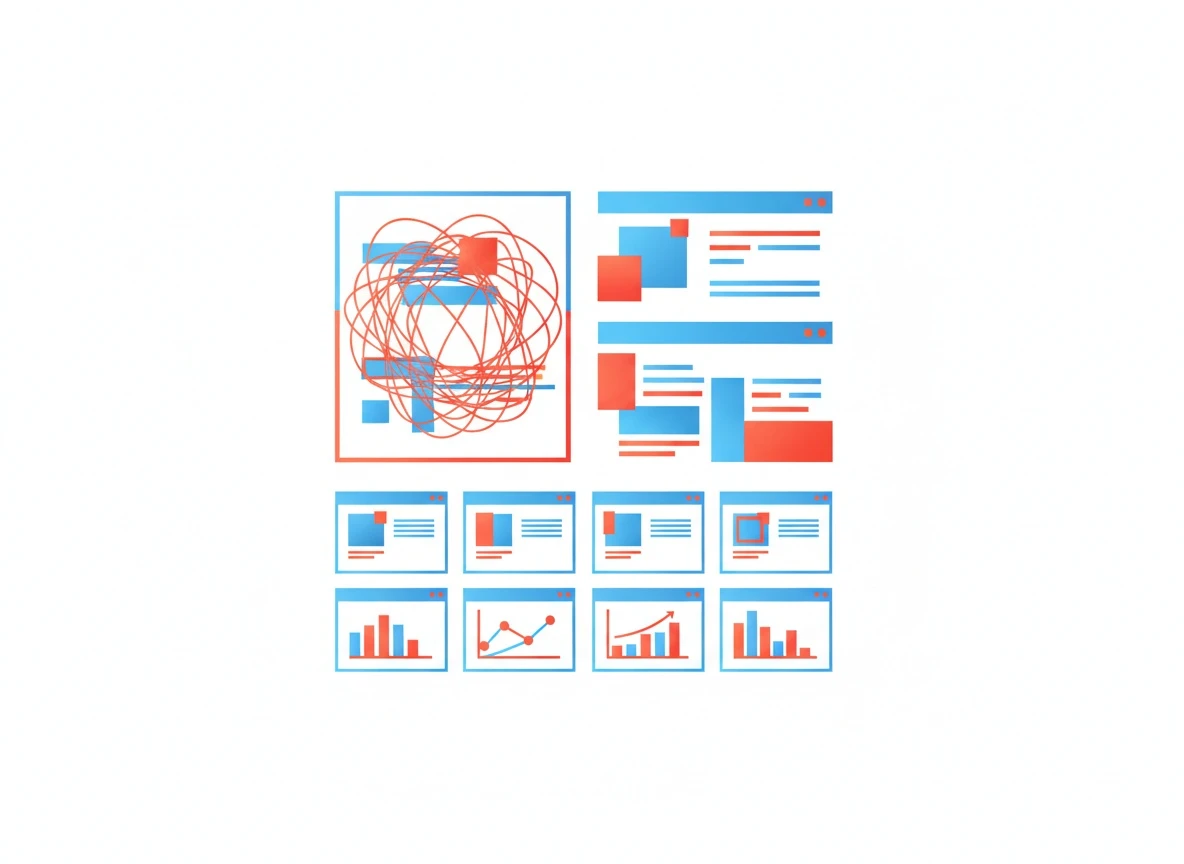
Higher cadence helps when it increases topical coverage without increasing SERP overlap. That means each post targets a different query set, answers a different intent, and earns internal links from relevant pages. If you publish daily but every post is basically “same keyword, slightly different wording,” you are manufacturing your own ranking competition.
Here’s the practical way I diagnose it: open your last 20 posts and ask, “If I removed the title, would these be obviously different pages?” If the answer is no, cadence is already hurting you.
Cadence is most valuable in three scenarios:
-
You are building a topical cluster where each page is a supporting node (examples, comparisons, templates, troubleshooting) that links back to a single pillar page. Done right, this compounds internal authority and improves crawl paths.
-
You have a distribution advantage (newsletter, community, sales team) that drives early engagement signals. Google does not rank based on “engagement” in a simplistic way, but pages that get discovered, crawled, and linked faster tend to stabilize faster.
-
You operate in a space where freshness is a ranking factor because the SERP is volatile (product updates, legal changes, pricing, fast-moving tools). Even then, freshness works best as updates to existing URLs, not endless new ones.
Cadence hurts when it triggers any of these failure modes:
- Index bloat: you publish faster than Google can evaluate quality, and your Index Coverage fills with “Crawled - currently not indexed” or “Discovered - currently not indexed.” Google’s own documentation is clear that indexing is selective and quality-weighted, not guaranteed for every URL: see Google Search Central on crawling and indexing.
- Thin differentiation: multiple pages answer the same question with the same structure, which looks like templated content at scale.
- Brand voice drift: AI output diverges across authorship, tone, and claims. Readers bounce, sales cycles slow, and your best pages stop converting even if they rank.
A clean rule you can quote to your team: If two drafts would rank for the same top 3 queries, they should probably be one page.
If you want the data-driven version of timing, not folklore, keep this bookmarked: Best time to post blog articles: data you need. Timing can help distribution, but it won’t save a site from cannibalization.
How do you prevent keyword cannibalization as you scale?

Keyword cannibalization is when multiple URLs compete for the same intent and Google keeps swapping which one ranks. You’ll see impressions spread across two or more pages, unstable positions, and lower-than-expected CTR because the “wrong” page appears.
The fix is not “publish less.” The fix is intent mapping + canonical ownership.
Step 1: Assign one query family to one primary page
Pick the page that should own the main query. That page becomes the canonical answer. Supporting posts are allowed to mention the topic, but they must clearly target a different angle (sub-intent) and link to the primary.
A fast way to validate SERP overlap is to run two searches and compare results: your target query and your proposed new title. If 5-7 of the top 10 results are the same, you’re about to cannibalize.
Step 2: Build a simple intent map before you publish
I keep this as a one-page sheet for founders. You can do it in a spreadsheet.
| Planned URL | Primary query | Intent type | “Must include” differentiator | Internal link target |
|---|
| /best-time-to-post/ | best time to post | informational | data, cadence framework | links to cluster nodes |
| /content-refresh-schedule/ | content refresh schedule | informational | 90-180 day process | links back to pillar |
| /ai-content-quality-checklist/ | AI content quality checks | procedural | QA gates, examples | links back to pillar |
If you cannot fill the “differentiator” column in one sentence, do not publish the page.
Step 3: Use canonicals and consolidation when overlap already exists
If you already published near-duplicates, you have three options: merge, redirect, or re-scope.
- Merge when both pages have value. Combine the best sections into one stronger URL, then 301 redirect the weaker one.
- Redirect when one page is clearly inferior or redundant.
- Re-scope when the page can be repurposed to a distinct intent (for example, turning a generic “on page SEO checklist” into “on page SEO services for product pages” with different SERP competitors).
Canonical tags help only when content is substantially similar and you want one URL indexed. They are not a magic fix for strategic overlap. If you need a refresher on canonical behavior, Google’s guidance is the baseline: Google Search Central on canonicalization.
One more practical warning: internal links can accidentally create cannibalization. If ten posts all use the same anchor text pointing to different URLs, you are telling Google those pages are interchangeable. Choose one destination per anchor theme.
For a deeper breakdown of why “good content” still fails when architecture is wrong, this is worth reading: Why your website has great content but still doesn't rank.
What quality checks keep AI content useful and original?
AI quality is not about sounding human. It’s about being verifiably correct, uniquely helpful, and structurally aligned with search intent. I’ve seen teams publish 200 posts in 60 days, then wonder why leads drop. The posts were readable. They were also interchangeable.
These are the checks that actually move rankings and trust.
The “SERP delta” check (originality that Google cares about)
Before you publish, scan the top results and write down what they all have in common (sections, examples, definitions). Then force your draft to add a delta: a process, a decision tree, a benchmark, a template, a real example, or a constraint-based recommendation.
A standalone sentence that earns citations in AI search: If your article does not contain at least one decision rule that changes what the reader will do next, it’s not publish-ready.
The evidence check (E-E-A-T in practice)
E-E-A-T is not a badge, it’s proof. Add at least one of these:
- A specific metric you’ve observed (example: “After consolidating 14 overlapping posts into 4 intent-led pages, clicks rose 31% in 6 weeks.”)
- A verifiable external citation for a claim that matters
- A concrete screenshot-worthy process (even if you don’t include the screenshot, the steps must be replicable)
When you cite performance and crawling behavior, don’t hand-wave. For example, page experience and speed still matter for users and crawl efficiency. Google’s documentation on Core Web Vitals is the reference I use when clients try to ignore load and layout stability.
The “brand voice drift” check
If you publish daily with multiple prompts, your voice will drift unless you lock it down. The fix is a voice spec plus a short QA gate: “Does this sound like us? Would sales send this to a prospect?”
If your AI content reads robotic, the problem is usually inconsistent constraints, not the model. This guide shows the practical fixes: Blog Brand Voice Matching Fix Robotic Ai Blog Posts.
The on-page SEO check (the boring stuff that still wins)
On page SEO services are often sold as “optimize titles and headings.” The real wins at scale are internal links, intent alignment, and eliminating duplication.
I use a short publish gate:
| QA gate | What “pass” looks like | What “fail” looks like |
|---|
| Search intent match | intro answers the query in 2-3 sentences | slow preamble, unclear promise |
| Unique angle | includes a delta vs top SERP pages | same outline as everyone else |
| Internal linking | links to the canonical page and one related node | orphan page, random anchors |
| Duplicate risk | no reused paragraphs across posts | templated sections reused verbatim |
| Claims | claims are sourced or framed as experience | invented stats, vague “studies show” |
If you want a blunt overview of the mistakes that trigger distrust, use this as your checklist: AI writing mistakes that hurt SEO and trust.
How do you schedule updates and refreshes?
A refresh schedule is how you get the benefits of freshness without creating new URLs that cannibalize your winners. Most founders do the opposite: they publish new posts because it feels productive, while their existing pages decay.
I run refreshes on a 90-180 day loop depending on velocity. Here’s the workflow that works even for small teams.
Step 1: Pick refresh targets from Search Console, not your gut
In Google Search Console, pull pages with high impressions and declining CTR or slipping average position. Those are usually “nearly right” pages that need better intent match, better snippet, or updated coverage.
Then check Index Coverage for wasted crawl. If you have hundreds of low-value indexed pages, your refresh schedule should start with consolidation, not rewriting.
Step 2: Refresh by intent, not by date
“Update for 2026” only helps if the SERP wants freshness. Refreshes that move rankings usually do one of these:
- Expand the page to cover missing sub-questions that show up in “People also ask”
- Add internal links from newer posts back to the refreshed page
- Replace generic sections with a worked example, a template, or a decision rule
- Consolidate overlapping posts into the winner and redirect the rest
Step 3: Maintain a simple cadence that matches your crawl reality
If your site is new or low authority, daily publishing can outpace crawl and evaluation. A better pattern is to publish fewer net-new URLs and spend the extra time refreshing, consolidating, and strengthening internal links.
If you’re choosing between “daily AI posts” and “3 strong posts plus 2 refreshes per week,” the second option wins more often than founders expect.
For platform-level execution, this is where end-to-end automation matters. VellumUp was built for teams that want research, writing, images, and direct publishing without copy-pasting into CMS editors. If you’re on WordPress, Shopify, Wix, or Webflow, start by checking supported auto-publishing integrations so cadence does not collapse under manual ops.
Frequently Asked Questions
What does DR stand for in SEO?
DR usually means Domain Rating, a third-party metric (popularized by Ahrefs) that estimates backlink strength. It’s useful for relative comparison, but it’s not a Google ranking factor.
What is DR and PR in SEO?
DR is Domain Rating (a tool metric). PR often refers to PageRank, Google’s original link analysis concept; public PageRank scores are no longer updated, but link authority still matters.
How do I duplicate a page in WordPress without a plugin?
Create a new page, then copy the content from the old page in the editor and paste it into the new one. After publishing, set a canonical (or noindex) if the pages are similar, otherwise you risk duplicate content.
How do you cite a website in APA 7?
APA 7 typically includes author (or organization), date, page title, site name (if different), and URL.
Your next step: open Search Console, pick one topic where you already have 2-4 overlapping posts, and consolidate them into one canonical page with tighter intent and stronger internal links. Then set a sustainable cadence where every new URL has a distinct SERP job, and schedule your first refresh sprint for 90 days from now.
A practical cadence decision framework (so “best time to post” stops being a debate)
The best time to post is the time you can sustain without lowering quality or creating overlap. That’s not motivational advice, it’s an operational constraint.
Use this quick table to choose a cadence that matches your current risk.
| Your current situation | Best move | What to measure weekly |
|---|
| Few pages, unclear positioning | publish 1-2x/week, validate intent | impressions per page, query diversity |
| Publishing often, rankings unstable | consolidate and refresh, slow new URLs | cannibalization swaps, CTR, index coverage |
| Strong topical cluster forming | increase cadence inside the cluster | internal link growth, non-branded clicks |
| Lots of “not indexed” URLs | pause, improve quality, reduce bloat | coverage report, crawl stats, redirects |
A sentence I’ve used with founders who want to go daily: Speed is only an advantage if it compounds authority into a smaller number of winning pages.
If you need help diagnosing whether cadence or quality is your bottleneck, start with a simple site scan and a content inventory. VellumUp’s workflow begins from a pasted URL and builds a publish schedule that avoids cannibalization while matching your voice. You can see how that works in practice in what an AI website scan learns from your URL.

 VellumUp11 min read