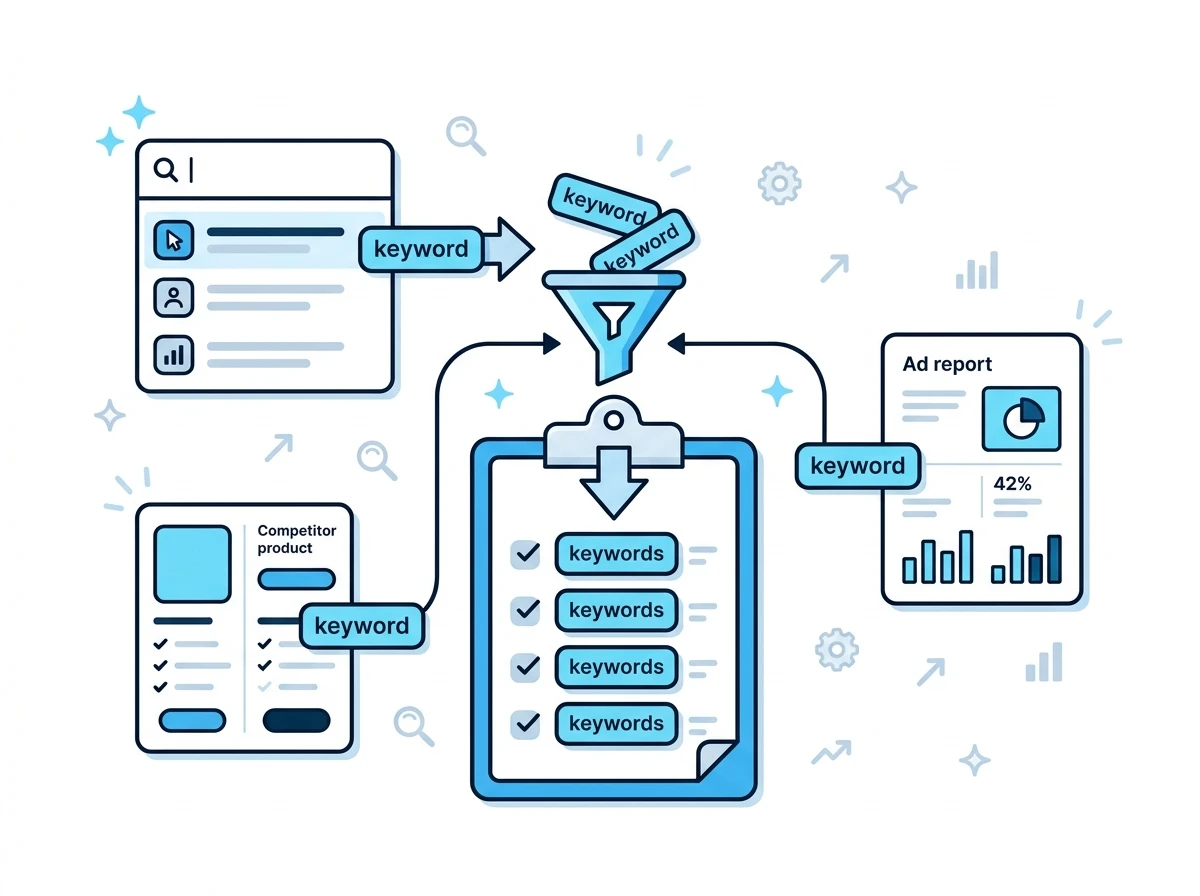
The best free amazon keyword research tool is a small stack: Amazon autocomplete for discovery, native Amazon data or advertising reports for validation, and Google Trends for seasonality. This guide compares the strongest no-cost options, explains their data limitations, and shows how to turn scattered keyword exports into a listing-ready priority map.
What Should the Best Free Amazon Keyword Research Tool Actually Prove?
The best free Amazon keyword research tool should reveal how shoppers describe a product, provide some indication of demand, and preserve the marketplace context. A generic SEO database can surface related phrases, yet its Google volume says little about purchasing behavior inside Amazon.
Evaluate each option against six practical criteria:
Selection criterion
What usable data looks like
Warning sign
Data source
Amazon autocomplete, native query data, ad search terms, or documented estimates
The provider does not explain where terms originate
Marketplace coverage
Data can be selected for the Amazon country you sell in
US and international searches are mixed together
Demand signal
Search frequency rank, estimated volume, impressions, or ad activity
An unexplained score presented as exact demand
Product relevance
Terms describe the product, use case, material, audience, or differentiator
High-volume phrases that refer to another product type
Competitor visibility
Reverse ASIN or listing extraction identifies terms associated with competing products
Results reproduce title words without ranking context
Workflow usefulness
Copy, filtering, grouping, or export supports listing optimization
One-term lookups that create hours of manual cleanup
Source proximity matters more than cosmetic precision. Amazon Brand Analytics data sits closer to actual marketplace behavior than a third-party estimate displaying an impressive-looking monthly number. Amazon explains how sellers can use search terms and query performance within its official Amazon Brand Analytics documentation, although access depends on account and brand eligibility.
Relevance carries equal weight. A broad phrase may have substantial demand while attracting shoppers expecting a different size, material, compatibility standard, or price point. For a wider explanation of commercial relevance, competition, and keyword selection, use VellumUp's practical framework for choosing viable keywords.
Which Best Free Amazon Keyword Research Tool Picks Produce Usable Terms?
The strongest free Amazon keyword research tools serve different jobs. Amazon autocomplete generates authentic query patterns, Ahrefs adds directional volume, Keyword Tool.io expands long-tail variations, and restricted Helium 10 access can expose competitor terms. Eligible sellers should place Amazon Brand Analytics and advertising reports above every third-party estimate.
Tool or data source
Best use
Data provided
Main limitation
Skip it if
Amazon autocomplete
Initial term discovery
Marketplace suggestions generated from shopper searches
No volume, export, or competitive metric
You need bulk research across many products
Ahrefs Amazon Keyword Tool
Public keyword expansion with demand estimates
Related terms and estimated Amazon search volume
Estimates require independent validation
You need listing-level competitor data
Keyword Tool.io
Long-tail autocomplete mining
Prefix, suffix, and modifier variations
Useful metrics are restricted on the free version
You only want validated demand figures
Helium 10 free access
Limited reverse ASIN and seed expansion
Samples from Cerebro, Magnet, or related tools
Usage limits and available features can change
You need repeatable catalog-wide analysis
Amazon Brand Analytics
Native query and competitor-product analysis
Search query, click, cart, and purchase signals where available
Requires an eligible seller and brand account
You do not control an eligible brand
Amazon Ads search term reports
Conversion validation
Actual shopper queries tied to campaign activity
Requires campaigns and enough activity to interpret
You have no advertising data yet
Amazon autocomplete is the best universal starting point. Enter the product noun, then add meaningful modifiers such as material, intended user, compatibility, size, problem, or use case. Repeat the research in the actual marketplace where the listing will appear, since vocabulary and suggestions vary by locale.
A free keyword research tool with search volume can improve prioritization, but estimated volume remains directional. Ahrefs' free Amazon generator is useful because it associates keyword ideas with an Amazon-specific demand estimate rather than substituting Google Keyword Planner data. Treat nearby volume values as roughly comparable signals, not audited marketplace totals.
Keyword Tool.io works well for long-tail expansion because it systematically mines autocomplete combinations. The free output is still valuable when a seed term has several common use cases, such as "travel coffee mug for car," but volume and competitive analysis are restricted.
Helium 10 is the practical freemium choice when limited reverse ASIN access is available. Reverse ASIN data can uncover phrases associated with a competing listing that never appear in its visible title, although free account limits make the tool unsuitable for continuous monitoring. Sellers ready to compare paid capabilities can use our Amazon SEO tool selection guide for ranking listings to assess rank tracking, listing optimization, and competitive coverage.
A free PPC keyword research tool should expose real search terms
A free PPC keyword research tool becomes valuable when it reports what shoppers typed before clicking or ordering. Amazon Ads reports connect queries to campaign activity, which makes them stronger validation evidence than a third-party difficulty score. Amazon's advertising reporting guide explains the available report categories and how advertisers can use them to assess performance.
Search term reports also expose vocabulary gaps. A listing might target "laptop stand" while converting shoppers repeatedly use a compatibility, material, or ergonomic modifier absent from the page. Those terms deserve review for the title or bullets if they accurately describe the product.
How Do You Validate Free Keyword Outputs and Avoid False Volume?
Validate free keyword outputs by triangulating discovery data against Amazon visibility, native account evidence, and commercial relevance. A volume estimate should influence ordering only after the query clearly matches the product and shopper expectation.
Use this sequence:
Normalize the terms. Remove duplicates, plural variants with identical meaning, competitor trademarks you cannot use safely, and phrases describing unsupported features.
Confirm Amazon relevance. Search the phrase in the correct marketplace and inspect the dominant result type. If the SERP primarily shows a different product category, the term carries weak listing relevance regardless of volume.
Look for independent evidence. Check autocomplete, limited reverse ASIN outputs, Brand Analytics, and Amazon Ads search terms. Confidence rises when unrelated sources surface the same phrase.
Adjust for seasonality. Compare demand patterns in Google Trends using its documented search controls, while remembering that Google Trends measures Google interest rather than Amazon purchase searches.
Map each accepted term to a listing field. Place the highest-relevance primary phrase in the title where it reads naturally, supporting benefits and use cases in bullets, and valid residual terms in backend search terms.
Competitor listing mining needs the same discipline. Repeated wording across top listings may indicate category language, copied optimization habits, or mandatory product specifications. It does not prove demand. Reverse ASIN ranking data, autocomplete visibility, and advertising conversion evidence make the distinction clearer.
False precision is a common failure mode. Two tools may report very different volumes because they use separate panels, update schedules, matching rules, and models. Compare terms within the same dataset, then use Amazon-native evidence to decide which phrases deserve prominent placement.
Amazon's own keyword research guidance for sellers recommends using relevant terms throughout listing content while avoiding irrelevant keyword use. That principle protects both indexing quality and conversion: attracting the wrong shopper can produce impressions without sales.
How Should Free Keyword Data Map to Titles, Bullets, and Backend Terms?
A prioritized Amazon keyword list should separate primary intent, feature and use-case language, and residual relevant variants. Dumping every discovered phrase into the title creates an unreadable listing and wastes high-value SERP real estate.
Listing field
Keyword role
Selection rule
Product title
Primary product identity and decisive qualifier
Use the clearest high-confidence phrase that precisely describes the item
Bullet points
Benefits, materials, compatibility, audience, and use cases
Match each term to a substantiated product attribute
Product description or A+ content
Contextual and objection-handling language
Expand concepts that require explanation rather than repetition
Backend search terms
Relevant synonyms, spelling variants, and residual vocabulary
Add useful terms that do not fit naturally in customer-facing copy
PPC campaigns
Discovery and validation terms
Test uncertain queries before assigning them prominent listing space
Create three working columns beside every keyword: evidence source, intent match, and destination field. A phrase appearing in autocomplete and a converting search term report has stronger evidence than one found only in a competitor title. A phrase that accurately describes a minor use case may belong in a bullet, while the core product noun and purchase-defining qualifier belong in the title.
Indexing and ranking are separate outcomes. A listing can become eligible for a query without earning a meaningful organic position. Rank depends on factors beyond keyword inclusion, including relevance, conversion behavior, offer competitiveness, and sales performance. Our guide to using Amazon SEO tools to improve listing rankings covers that broader operational layer.
When Should You Stop Using a Free Amazon Keyword Research Tool and Upgrade?
Upgrade when free usage limits distort decisions or make the workflow too slow to repeat. A single-product seller can work effectively with autocomplete, a public keyword generator, and native campaign data. A team managing a growing catalog needs persistent datasets, bulk reverse ASIN analysis, rank tracking, and reliable exports.
Upgrade signal
Why free tools fail
Capability worth paying for
Several close competitors require analysis
Manual lookups hide common and unique keyword gaps
Informal files create version and ownership problems
Shared workspaces and change tracking
Paying for software makes sense when the saved labor and avoided listing mistakes outweigh the subscription. Do not upgrade merely to obtain a larger number beside each keyword. Upgrade for repeatability, historical tracking, and competitive depth.
Free tools also remain useful after an upgrade. Autocomplete offers a quick reality check, Amazon account data stays closest to customer behavior, and Google Trends can flag seasonal movement outside a tool's proprietary model.
Frequently Asked Questions
Can I do Amazon keyword research for free?
Yes. Combine Amazon autocomplete, a free Amazon keyword generator, limited reverse ASIN access, and any Brand Analytics or advertising data available in your seller account. Expect manual cleanup and fewer historical metrics than a paid suite provides.
How should beginners do Amazon keyword research?
Start with the exact product noun, then expand it using materials, features, audiences, compatibility requirements, and use cases. Validate each phrase against Amazon results before assigning it to the title, bullets, backend terms, or PPC campaigns.
Does Amazon provide exact keyword search volume?
Amazon provides native search and query signals through seller features such as Brand Analytics, but availability and metric format depend on account eligibility. Third-party tools usually model search volume, so their figures should be treated as estimates.
Can Google Keyword Planner replace an Amazon keyword research tool?
No. Google Keyword Planner reflects Google Ads search behavior, which differs from Amazon's product-focused search environment. It can reveal vocabulary or broader trends, but Amazon-specific sources should control listing decisions.
Are free reverse ASIN tools accurate?
They can produce useful competitor keyword samples, but free tiers commonly restrict searches, rows, filters, or historical context. Confirm important terms through Amazon search results, autocomplete, native query data, or PPC search term performance.
The best free amazon keyword research tool is the stack that gives you credible discovery, validation, and field-level decisions without pretending that modeled volume is exact. Once manual research starts blocking consistent optimization or publishing, register with VellumUp to build a more automated keyword research and content workflow across your websites.