If you are using an ai essay writer free tool, you can get a decent first draft fast, but you usually give up control: shorter outputs, weaker citations, limited tone options, and more risk around originality and policy compliance. This guide breaks down the real differences between free and paid plans so you can decide when free is enough and when upgrading saves you time, grades, or brand trust.
AI Essay Writer Free vs Paid: the real tradeoffs (not marketing)
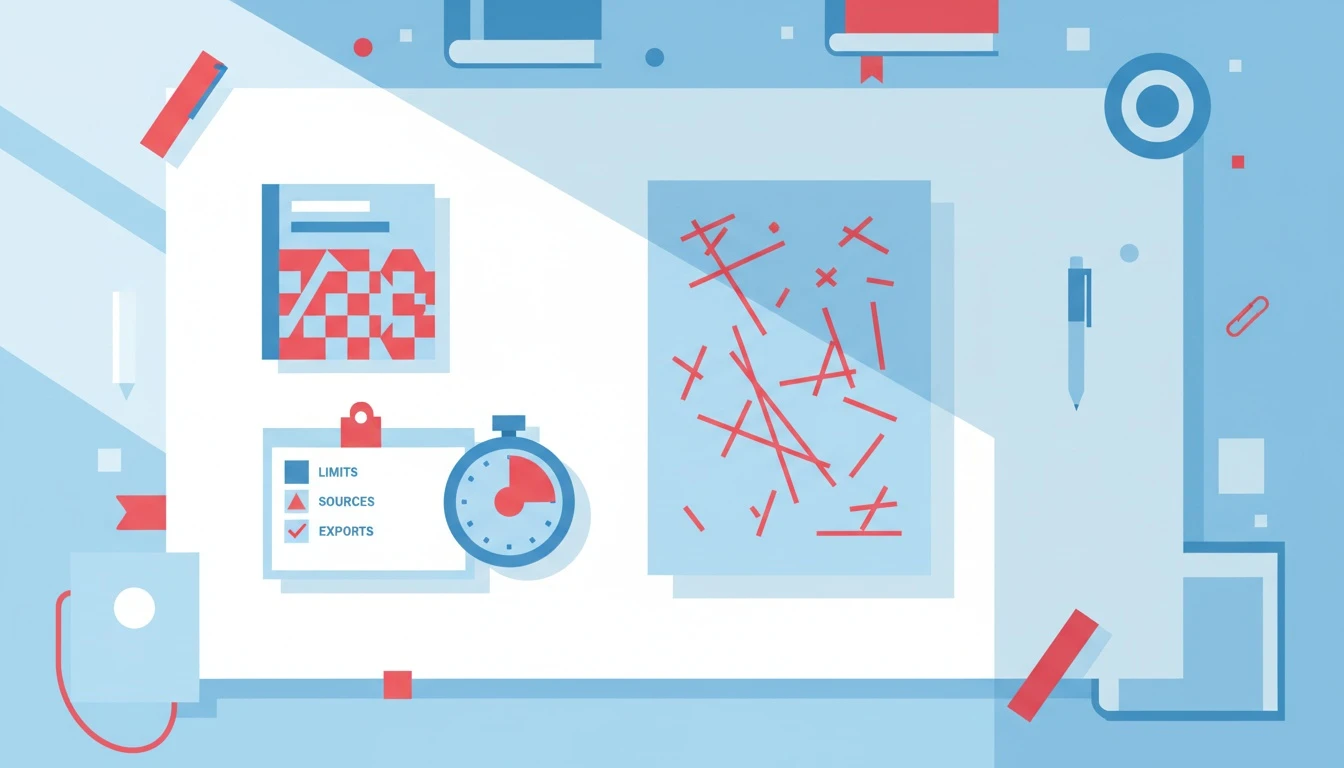
AI essay writer free plans are built to prove the product works, not to carry your whole workflow. In practice, the gap shows up in five places: length limits, research and citations, originality checks, tone and structure control, and exports.
A clean way to think about it is this: free plans optimize for speed and acquisition; paid plans optimize for reliability and repeatability. If you only need a brainstorming partner for an outline, free is fine. If you need something you can submit, publish, or share with a team, the missing controls start to hurt.
One sentence you can keep: Free tools generate words; paid tools reduce risk.
Word limits and context windows: why quality drops on longer essays
AI writing tools live and die by context. The model needs room to hold your prompt, your outline, key facts, and what it already wrote. Most free plans cap either the output length, the number of runs per day, or the amount of context the model can keep.
That is why free outputs often feel repetitive halfway through. The tool is not “dumber”; it is constrained.
Here is what we see most often when people try to write a 1,500 to 3,000 word essay on a free tier:
The introduction is strong, then body sections drift off-topic.
Definitions repeat because the tool forgets what it already established.
The conclusion adds new claims instead of synthesizing.
Paid plans typically unlock longer generations, higher context windows, and features like “continue with full memory” or section-by-section drafting that keeps your thesis consistent.
For a benchmark, Google’s own guidance on helpful content pushes clarity and consistency over sheer length, and the same principle applies here: longer is only better when it stays coherent. The moment coherence breaks, you lose time rewriting. Google’s perspective is worth reading in their helpful content guidance.
Citations and sourcing: the biggest difference between “draft” and “usable”
Citations are where most ai essay writer free tools fall apart. Free tiers often do one of three things:
Provide no citations at all
Provide “citations” that are not verifiable
Provide links but not quote-level attribution
If your essay needs MLA, APA, Chicago, or even just credible sources, you want a tool that can do source-aware writing. That means it can:
pull from real, accessible sources,
attach claims to specific sources,
format citations correctly,
and keep the source list consistent as you revise.
A paid plan does not guarantee perfect citations, but it usually adds the plumbing needed for them: browsing, source libraries, citation formatting, and sometimes quote extraction.
Reality check from the field: we have reviewed essays where 30-40% of the bibliography entries were not real when generated on a free tier. That is not a small “oops.” That is a failing grade or a credibility hit.
If you want a grounding reference for what “good” looks like, Purdue OWL’s APA formatting and style guide is the standard many schools use, and it makes it obvious when a tool is faking it.
Originality and detection risk: what free plans do not tell you
Originality is two separate issues that people mix up:
Plagiarism (copying existing text)
AI detection (a classifier guessing text was AI-assisted)
Free plans often skip built-in plagiarism checks or only provide a shallow scan. Paid plans are more likely to include plagiarism detection, version history, and rewrite controls.
On “AI detection,” be careful. No honest tool can promise you will “pass” every detector. Detectors change constantly, and even OpenAI has acknowledged limits of AI classifiers. If you want the source, OpenAI retired its own AI classifier and explained why in their AI classifier update.
What you can control is the writing process:
Use your own outline and sources.
Add specific examples from your class material or your own notes.
Rewrite for your natural voice and sentence rhythm.
Keep claims tied to citations.
If you publish online, the same principle applies to SEO and trust. Automated content that reads generic gets ignored. We see it every week, which is why we wrote AI writing mistakes that hurt SEO and trust with the exact patterns that trigger low engagement.
Tone control and structure: why “sounds good” is not the same as “fits the assignment”
Tone is not just “formal” vs “casual.” Essays often need a specific stance and structure: argumentative, comparative, reflective, narrative, literature review, or problem-solution.
Free tools usually give you a single generic output style. Paid tools more often let you lock:
thesis clarity,
paragraph intent (claim, evidence, analysis),
reading level,
and constraints like “no first-person” or “use counterarguments.”
If you have ever had a tool write a polished paragraph that still earns a low grade, this is why. The writing can be fluent but structurally wrong.
This is also where “humanizer” features get marketed hard, like “walter writes ai humanizer.” The useful version of that feature is not “make it undetectable.” The useful version is: make the writing match a real voice and a real rubric.
If you are choosing between tools, the fastest way to spot quality is not the sample output. It is whether you can give the tool a rubric and have it follow it.
For website publishing, brand voice is the equivalent of a rubric. If you want a practical breakdown of how to fix robotic output, Brand voice matching for AI blog posts shows what to lock and what to let the model improvise.
Export options and workflow: the hidden cost of “free”
Export sounds boring until you need it. Free plans often trap you in the editor or give you messy exports that break formatting.
Paid plans commonly unlock clean export formats and integrations:
DOCX with headings that survive Google Docs or Word
PDF export for submission
Markdown for publishing
Direct publishing or CMS integrations for content teams
This matters if your essay is part of a bigger workflow: peer review, supervisor approval, or publishing.
For teams running content as a system, this is where “content machines” become real. You stop thinking “write one thing” and start thinking “plan, draft, edit, publish, interlink, update.” VellumUp is built for that end-to-end loop, including auto-publishing through website integrations like WordPress, Shopify, Webflow, Wix, and webhooks.
Feature comparison table: what you actually get when you pay
ai writer free plans vary, but the patterns are consistent. Use this table as a decision filter.
Feature that affects outcomes
Typical free plan
Typical paid plan
Why it matters
Output length and daily limits
Short runs, low caps
Longer runs, higher caps
Long essays need continuity, not stitched fragments
Citations and sourcing
None or unreliable
Source tools, formatting, libraries
Bad citations cost grades and trust
Originality checks
Often missing
Plagiarism scan, revision history
Reduces accidental copying and improves traceability
Tone and rubric control
Basic tone toggles
Detailed constraints, templates
“Fluent” is not “meets assignment requirements”
Export formats
Copy-paste only
DOCX/PDF/Markdown, cleaner formatting
Saves time and prevents formatting errors
Collaboration
Rare
Shared projects, comments
Necessary for teams and editing cycles
If you are trying to pick the best ai for writing in 2026, do not start with “which model is smartest.” Start with “which workflow is safest.” We laid out the selection criteria in Best AI for writing: how to choose in 2026.
When an AI essay writer free tool is enough (and when it is not)
ai essay writer free is enough when the goal is speed and the downside is low. Think: brainstorming, outlines, rephrasing a paragraph you already wrote, or generating discussion questions.
It is not enough when any of these are true:
Your assignment requires verifiable citations.
You need to hit a strict word count with consistent argument flow.
You are writing in a graded or compliance-heavy setting.
You need a specific voice, structure, or rubric adherence.
You need clean exports for submission.
A practical rule: If you would be embarrassed to show your sources, you are not ready to submit the essay. Free tiers make that problem more common because they hide the sourcing step.
Frequently Asked Questions
Do publishers check for AI writing?
Yes, many do, especially in education and editorial workflows. More importantly, they check for weak reasoning, missing citations, and generic phrasing, which are the most common AI tells.
Does Walter write pass AI detection?
No tool can honestly guarantee passing AI detection across all detectors and policies. Your best protection is a real outline, real sources, and revision that adds specific evidence and original analysis.
Is Walter writes AI legit?
Legitimacy depends on what you mean: the tool may work, but you still need to verify citations and follow your school or publisher’s AI policy. Treat any output as a draft until you have checked sources and structure.
Does Walter write AI cost money?
Most tools in this space use a free tier to demonstrate output and a paid plan for longer limits and controls. The cost question is really whether paying saves more time than it costs for your use case.
Next step: decide based on risk, not hype
Start by writing down what your essay must include: required citation style, word count, number of sources, and whether first-person is allowed. Then test your ai essay writer free tool against that checklist with one section of your essay, not the whole thing.
If the tool cannot produce verifiable citations and a stable structure in a 600-800 word sample, upgrading is usually cheaper than rewriting from scratch. If you want an automated content engine for publishing (not just drafting), start with a site scan and connect your CMS through VellumUp’s supported integrations so planning, writing, internal linking, and publishing happen in one flow.

 VellumUp8 min read